The Dyrt: RV & Free Camping
- 4.6
- Rating
- 1.00M
- Installs
- Free
- Price

 Analysis by App-foxy
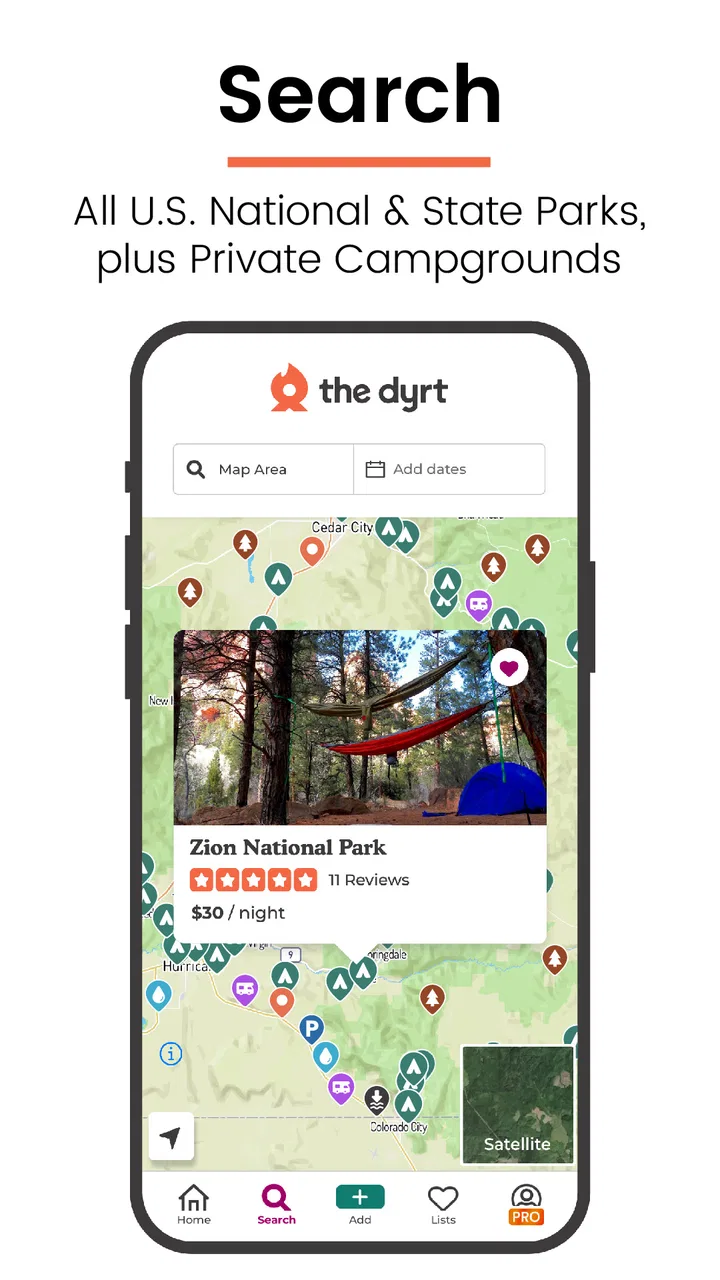
Planning a camping trip often begins with a simple question: where can I actually stay? The answer becomes less simple once I have to compare state parks, national parks, RV parks, and less conventional places to spend the night. The Dyrt is built around that problem, bringing those different camping possibilities into one travel and local app instead of making me search across several unrelated sources.
After using it as a planning companion, I found its strongest quality is not the novelty of browsing campsites. It is the way the app can become part of a repeatable trip routine. I can start with a broad area, narrow the search around the kind of camping I want, read what other campers experienced, and save promising options before making a final decision. That workflow makes more sense for frequent campers and road-trippers than for someone who only needs a single overnight stop.
The app is free to download, with optional in-app purchases ranging from $3.99 to $119.99 per item. It comes from The Dyrt, sits in the Travel & Local category, and carries a Teen content rating. Its overall rating is 4.6 from around 31 thousand ratings, while the app has passed one million installs. Those figures suggest that it has become a familiar tool for a substantial camping audience, but popularity alone does not decide whether it deserves a permanent place on my phone.
You May Also Like

 Blood Strike: 2.5 Anniversary
Blood Strike’s Loadouts Turn Every Drop Into a Tactical Gamble
A close look at Blood Strike’s custom loadouts: how fast access to signature weapons reshapes its battle royale rhythm, rewards preparation, and narrows the gap between fights.

 Pandora - Music & Podcasts
Pandora’s Music Is Easy to Start, but Harder to Recover
Pandora’s strength is its low-effort path from a seed to a station. Its weak spot is how much confidence it asks you to place in connection, setup, and quiet recovery.

 8 Ball Pool
 Is Built on Rivalries, Rematches, and Routine
A close look at the rivalries, rematches, shared routines, and unanswered safety questions that turn a quick pool match into a persistent mobile community.

 Samsung Music
’s Quiet Strength Is Playing What You Already Own
Its reach comes less from spectacle than from dependable access to a personal library. That simplicity is both the app’s strongest retention engine and its ceiling.

 AccuWeather: Weather Radar
AccuWeather Review: A Quick, Clear Forecast for Everyday Decisions
For everyday plans, the best forecast is the one you can understand quickly. AccuWeather makes rain timing, radar, and local conditions easy to act on, with a few trade-offs.

 Hill Climb Racing
Why Hill Climb Racing Still Turns Crashes Into One More Run
A tiny car, a bumpy hill and one more upgrade: Hill Climb Racing keeps resurfacing because its simple chaos makes every near-miss feel personal.
More From Our News Desk



From an appealing first week to a useful camping habit
I’d use this section to look beyond the first burst of campsite browsing and consider what makes the app worth reopening between trips. A small planning habit—keeping only realistic candidates and revisiting them when dates firm up—can make a broad search feel manageable rather than endless. That leads naturally to the next question: how well does the experience work for people with different needs and in different travel situations?
Why the first sessions feel productive
The first thing I liked was the breadth of the search idea. Instead of treating camping as one narrow category, the app is designed for people who may switch between a developed campground, an RV-friendly site, a state park, a national park, or free camping. That matters because the best option changes with the trip. A family weekend, a long RV route, and a low-cost overnight do not have the same requirements.
In the first week, the app is especially enjoyable for discovery. I can explore an unfamiliar destination and quickly build a mental map of what is available nearby. The useful part is not simply seeing more listings; it is comparing different types of stays without leaving the same camping-focused environment. That reduces the early planning friction when I do not yet know the local terminology or which areas are worth investigating.
The community material also changes how I evaluate a place. A formal description may tell me the basic identity of a campground, but camper experiences can draw attention to practical details that affect the decision. I use those observations as clues rather than treating every comment as a guarantee. Conditions can change, and one camper’s ideal site may be another person’s inconvenience, so I look for patterns across several impressions before relying on them.
One of my favorite early workflows is to search widely first, then become stricter. I begin by checking the region around my destination, note the range of camping styles, and only then decide what matters most: proximity, the type of park, a place suited to an RV, or the possibility of free camping. Starting with every preference locked in can hide alternatives that would have worked better.
A realistic weekend planning routine
Imagine I am leaving after work on Friday and want to spend two nights outside the city. I would use the app first to inspect the wider destination rather than searching only for the closest campground. I can compare a conventional park with an RV-oriented option and investigate free camping possibilities before committing to a route. That is valuable when the trip is flexible and the destination matters less than finding a comfortable, practical place to stay.
On the second pass, I would read the available camper feedback with a specific question in mind. I am not merely asking whether people liked the site. I want to know whether the location seems appropriate for my style of trip, whether the setting matches my expectations, and whether the experience sounds dependable enough for a short arrival window. This turns browsing into a decision process instead of an endless scroll.
The app is less useful if I expect it to make every decision for me. I still need to check the final booking or access details through the relevant camping provider, understand the rules of the destination, and confirm that the site suits my vehicle and group. The Dyrt helps me discover and compare possibilities; it should not replace common-sense preparation.
Who gets the most from the free starting point
The free version makes the app easy to try before deciding whether it belongs in a regular travel routine. I think it is most attractive to campers who are still learning how they like to travel. Someone moving from occasional tent trips into longer road journeys can use the broad campsite focus to understand the choices available in different regions.
It is also a natural fit for people who dislike maintaining several separate research systems. If I were collecting destinations through general map searches, reading scattered comments elsewhere, and keeping notes in another app, a camping-specific home base would be more convenient. The benefit grows when I plan more than one trip and want to return to the same style of research.
On the other hand, a person who already has a trusted campground network may find the first-week appeal limited. If I always stay at the same few parks and already know how to reserve them, a broad discovery tool may add little. The app earns its space when it helps me make better choices, not simply when it gives me another place to browse.
What changes after the novelty fades
Camping apps can be exciting during the first trip because every map and listing feels like a new possibility. The harder test is the following month, when I am not actively planning a vacation. In my experience, The Dyrt has recurring value when I use it as a preparation tool rather than as entertainment.
For a regular camper, the repeatable pattern is straightforward: explore an area, compare camping styles, inspect community experience, save realistic candidates, and return when the dates or route become clearer. That sequence is more useful than opening the app without a specific destination. A clear planning question keeps the search focused and reduces the fatigue that comes from looking at too many similar places.
The app’s coverage of state and national parks, RV parks, and free camping gives it a wider monthly role than a service devoted to just one type of campground. My needs may change from one trip to the next. One month I might want a straightforward park near a planned route; another month I may be willing to trade convenience for a more flexible or lower-cost option. The ability to investigate both without changing tools is the main reason I can imagine returning.
How I would use it across several trips
For a short trip, I would use it for discovery and comparison. For a longer road journey, I would use it earlier, while shaping the route itself. That distinction matters. A single destination search answers “where could I stay?” A multi-stop journey requires asking “which places make the entire route manageable?” The app is more valuable in the second situation because each stop can be considered as part of a larger plan.
I would also avoid treating every saved possibility as a real plan. Keeping a short list is useful; collecting dozens of attractive places creates a new problem. My practical rule would be to save only sites that fit a known route, a preferred camping style, or a backup need. This is one of the less obvious trade-offs of a broad discovery app: more options improve flexibility, but too many options make final decisions slower.
For RV travelers, the app’s emphasis on RV parks may make it a more natural monthly companion than a general travel app. Still, I would not assume that a listing automatically answers every vehicle-specific question. I would use the app to identify candidates, then verify the details that matter to my particular setup before traveling. That extra step is not a flaw unique to this app; it is part of responsible RV planning.
The maintenance work I still have to do
The biggest maintenance burden is not learning the interface. It is keeping my own expectations current. Camping conditions are seasonal, access can change, and community reports describe experiences from particular moments. I have to read recent-looking context carefully and avoid assuming that an old impression represents today’s situation.
That means the app does not eliminate research; it organizes much of it. I still need to confirm rules, availability, arrival requirements, and suitability through the appropriate official or booking channel. The Dyrt is strongest as a discovery and comparison layer, while the final responsibility remains with me. Anyone expecting one tap to settle every logistical question may become frustrated.
There is also a maintenance cost in learning how to interpret reviews. A complaint about crowds may be a warning for one traveler and irrelevant to another. A positive comment about remoteness may sound perfect until I realize that I need easy access or dependable facilities. I get better results when I translate comments into my own criteria instead of counting praise and criticism mechanically.
Another useful habit is to separate “interesting” from “appropriate.” A free camping option may be appealing because it changes the budget or the character of the trip, but that does not automatically make it the right choice for a late arrival, a first-time camper, or a group that needs predictable services. The app can broaden my options, but it cannot decide how much uncertainty I am willing to accept.
Where repeated use can become tiring
The same range that makes the app attractive can also create decision fatigue. When a region contains many possible places, browsing can start to feel like work. I sometimes find that the hardest part is not finding a campsite but deciding when I have enough information to stop searching.
Community reviews can contribute to that fatigue. They are valuable because they add human context, yet they also introduce different standards, incomplete descriptions, and conflicting impressions. I would rather see those differences than have no firsthand perspective, but I have to spend time interpreting them. For a quick overnight, that may feel excessive compared with using a familiar map or booking service.
The free-to-try model is another point to consider. Optional purchases may make sense for committed campers who want a deeper or more regular planning experience, but casual users should first establish whether the free experience already solves their problem. Because the available purchase range extends from a small item to a much larger one, I would pay attention to what each upgrade changes for my own workflow rather than buying simply because I plan to camp once.
There is also a psychological risk in relying too heavily on a single community. The app can make a destination feel understandable because I have read several camper impressions, but that confidence should not replace checking official information. I would be especially cautious when the trip depends on a narrow arrival time, a particular vehicle requirement, or conditions that could change quickly.
How it compares with ordinary alternatives
A general maps app is often faster for locating something close to a highway or checking driving directions. It may be the better choice when I already know the campground and only need navigation. The Dyrt becomes more useful before that point, when I am comparing unfamiliar places and want camping-specific context rather than a generic location pin.
A standard booking service can be more convenient when I have fixed dates and want to complete a reservation immediately. Its strength is transaction speed. The Dyrt’s strength is the broader research phase: deciding which kind of camping fits the trip and discovering alternatives that I might not have considered through a narrow booking search.
Official park resources remain important because they are the appropriate place to confirm regulations, closures, permits, and final access information. I would not use this app as a substitute for those sources. Instead, I see it as a practical bridge between inspiration and verification. It helps me form a shortlist, while official channels help me make the final call.
For someone who wants only free camping, a specialized resource may feel more direct. For someone who camps in several ways, the wider scope here is more convenient. That is the central comparison: focused tools can be quicker for a single need, while The Dyrt is more useful when my camping style changes from trip to trip.
Device expectations and practical setup
The app supports devices running Android 7.0 or later, which makes it accessible on many older Android phones as well as newer models. I would still prepare before leaving rather than assuming that every part of a trip will be comfortable with a weak connection. Saving key information in advance, taking screenshots of essential directions or details, and keeping an independent backup plan are sensible habits for any outdoor travel app.
I would also avoid making the phone my only source of navigation or trip information. A charged device, a power bank, and basic offline notes are more important than having a beautifully organized campsite list. The app can improve planning, but it cannot solve battery, signal, weather, or access problems.
Who should keep it installed
I would keep it installed if I regularly plan camping weekends, change destinations often, travel by RV, or like comparing developed and free camping possibilities. It has enough range to remain useful after the first trip, especially when I use it to build a shortlist instead of endlessly browsing.
I would probably skip it if I rarely camp, always return to one known campground, or mainly need turn-by-turn directions and immediate reservations. In those cases, a general map or a booking-focused service may be simpler. I would also be cautious if I dislike reviewing user-generated information or prefer every detail to come from one official source.
My long-term verdict is positive, with a clear condition: it earns lasting space when it becomes part of a deliberate camping workflow. The first-week discovery is enjoyable, but the lasting value comes from reducing repeated research across different kinds of trips. It does not remove the need to verify important details, and its range can create more choices than some travelers want. Even so, for campers who want one place to explore state and national parks, RV parks, and free camping, it is a practical companion rather than a one-trip novelty.
With version 5.42.0, the app remains a credible option for Android users who want camping research organized around real outdoor travel rather than generic tourism. I would start with the free experience, use it on one realistic trip, and judge the optional purchases by whether they save me time month after month. For my own use, that is the right standard: not how exciting the first search feels, but whether the next trip becomes easier to plan.
FAQs for The Dyrt: RV & Free Camping
01What features does The Dyrt offer for finding camping sites?
The Dyrt provides an extensive database of campgrounds, including RV parks and free camping spots, across the United States. Users can access detailed reviews, photos, and amenities information. The app also offers advanced filtering options to help campers find sites that suit their specific needs, such as pet-friendly areas or spots with Wi-Fi.
02Is The Dyrt free to use, or is there a subscription required?
The Dyrt offers a free version that allows users to browse and review campsites. However, for additional features like offline access, discounts at select campgrounds, and advanced map layers, users can opt for The Dyrt PRO subscription. This premium option provides an enhanced camping experience for a yearly fee.
03How reliable are the reviews and ratings on The Dyrt?
The Dyrt relies on its active community of campers to provide honest, user-generated reviews. Each review includes personal experiences, photos, and ratings, contributing to a comprehensive overview of the campsite. The app encourages transparency and accuracy by allowing users to update reviews and add new information as conditions change.
04Can I book campsites directly through The Dyrt?
While The Dyrt offers extensive information on campgrounds, it does not handle bookings directly. Instead, the app provides links and contact details for reservations. Some sites may offer online booking through third-party platforms, while others may require phone or email reservations directly with the campground.
05Does The Dyrt work offline, and how can I access maps without internet?
The Dyrt PRO subscribers can download maps and campsite information for offline access, making it a valuable tool for areas with limited connectivity. This feature ensures that campers can navigate to their destinations and explore nearby sites without relying on an internet connection, enhancing the overall camping experience.
Pros
- Easy to navigate user interface.
- Comprehensive campsite database.
- Offline access for remote locations.
- Detailed user reviews and ratings.
- Customizable search filters.
Cons
- Limited features in free version.
- Occasional app crashes reported.
- Some outdated campsite information.
- High battery consumption.
- Requires in-app purchases for full access.

The Dyrt: RV & Free Camping
Gallery